
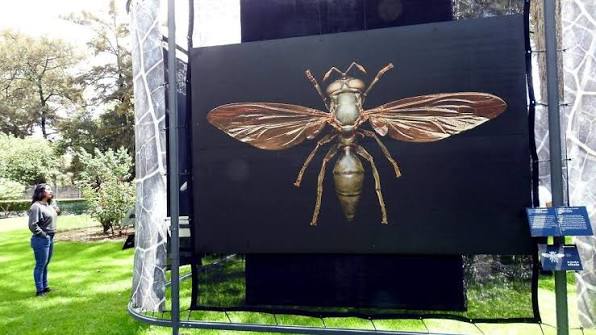
A renovated BUGarium at ABQ BioPark in Albuquerque, New Mexico, is seeking to bring visitors closer to insects and other invertebrates. The space gives spiders, scorpions and ants a prominent place in public environmental education, challenging the usual focus of zoos on large mammals.
The facility forms part of a complex that also includes an aquarium, zoological park and botanical garden. Live displays allow visitors to observe the diversity of small animals and learn how different species behave, reproduce and interact with their surroundings. The renovation focuses attention on animals whose ecological importance is often overshadowed by large mammals. A leaf-cutter ant colony allows visitors to observe the relationship between cooperation, food gathering and fungi cultivated underground.
Invertebrates perform ecological roles that are often overlooked. They help decompose organic matter, cycle nutrients, pollinate plants and form food webs that sustain birds, amphibians and mammals. Conservation discussions therefore cannot be limited to charismatic vertebrates.
Education can also confront fear and misunderstanding. Seeing unfamiliar animals in a supervised setting may help visitors distinguish genuine hazards from common myths, although the effect on attitudes depends on the quality of interpretation and the audiences reached. According to the facility's curators, glass chambers reveal the internal organization of the colony. Exhibits from the Chihuahuan Desert connect the BUGarium to habitats closer to New Mexico residents.
Captive displays demand careful animal welfare, appropriate habitat conditions and responsible sourcing. A renovated exhibit is an educational opportunity, but the opening itself does not prove a measurable increase in wild insect populations or changes in visitors' behaviour.
The published account focuses on the updated public attraction rather than a new experimental study. Its environmental relevance lies in making invertebrate diversity understandable and connecting everyday experiences with larger questions of habitat loss and ecological balance. The $1.45 million figure is a renovation cost, not a measurement of biodiversity gains. Protecting insects also depends on habitats outside the zoo. The educational question is whether visitors leave with a better understanding of arthropod ecology and welfare rather than seeing them only as curiosities.
Future evaluation could examine participation, learning outcomes and partnerships supporting field conservation. The BUGarium's potential contribution is to encourage attention to organisms that quietly sustain ecosystems yet are frequently absent from public debate.