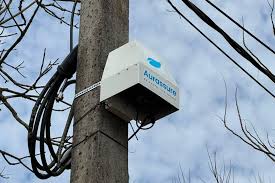
Curitiba will test Google AirView+ at six locations across the city. The launch is scheduled for August 13 at the Pinheiros Health Unit in Santa Felicidade, where one device will operate. Five additional sensors will be distributed to observe urban environments with differing conditions.
The network will do more than provide a general air-quality reading. According to the municipal announcement, it will also generate real-time data on temperature, humidity, precipitation, atmospheric pressure, and wind speed and direction. Combining those variables can help interpret how weather and urban circulation affect the concentration and dispersal of pollutants.
AirView+ uses low-cost sensors developed by Aurassure, an Indian technology company specializing in environmental solutions. The Google-linked platform applies artificial intelligence to process and integrate measurements. Curitiba will be the first city in southern Brazil to trial the system, so the initial phase is an operational experiment rather than an established monitoring network.
Sites were chosen to represent contrasts: densely developed districts, corridors with heavy vehicle traffic, and places near green areas. That diversity may reveal differences a single station could not describe. Six sites, however, do not amount to complete coverage of the city, nor can they identify the source of every pollutant on their own.
The municipality placed the trial within its Municipal Climate Change Mitigation and Adaptation Plan, PlanClima. Finer observations could support alerts, mobility studies and public-health decisions. Environmental benefits will nevertheless depend on converting data into action; installing sensors does not itself reduce emissions.
For the pilot to produce reliable evidence, Curitiba will need to assess data continuity, maintenance, consistency between devices and comparison with reference instruments. How results are communicated and which thresholds trigger responses will also matter. Affordable sensors can increase spatial density, but their public value depends on quality control and methodological transparency.
The new phase should show whether data remain available, how the six environments differ and whether the information is useful for management. If Curitiba publishes comparable series, documents calibration and connects findings to policies on traffic, burning and urban sources, AirView+ could move from demonstration to environmental tool. For now, the verified outcome is the start of the trial.