
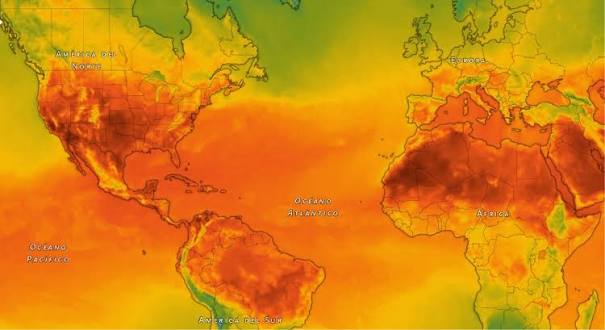
Average global sea-surface temperature reached 20.96°C in July 2026, the highest value recorded for that month. Copernicus's monthly report thus confirmed a second consecutive record after June. The mark combines a long-term warming trend with the development of El Niño in the equatorial Pacific.
The tropical Pacific showed exceptional temperatures where El Niño's ocean-atmosphere coupling develops. The phenomenon redistributes heat and shifts rainfall, winds and storm tracks, but it does not act alone: greenhouse gases have raised the thermal baseline on which every natural oscillation operates.
The Atlantic around Europe and the Mediterranean also endured intense marine heatwaves. Prolonged warming stresses corals, fish and food webs and affects fisheries, aquaculture and coastal communities. A warmer surface also increases evaporation and can supply energy and moisture to extreme weather.
Western Europe recorded an average air temperature of 21.62°C, 2.79°C above the reference and beyond the 2022 record. France experienced its hottest July since measurements began in 1900. Heat and dryness favoured fires and smoke capable of travelling far, worsening air quality well beyond the flames.
Drought pushed the Seine, Rhine and Danube to historically low levels, affecting agriculture, navigation and freight prices. In Germany, some barges could carry only 20% of their normal loads. The figures show how ocean and land heat can move through supply chains, energy and food systems.
Globally, July averaged 16.9°C and statistically tied 2024 as the second-warmest July, behind 2023. It was 1.47°C above the 1850–1900 pre-industrial average. One month close to 1.5°C does not mean the Paris goal, defined over long-term averages, has been permanently exceeded.
Copernicus also observed unusual dryness in Canada, the United States, China, Argentina, Uruguay and Bolivia, while southern Brazil was wetter than average. Coming measurements will show how much El Niño adds to stored heat. Monitoring should combine surface and deep temperature, marine heatwaves, ecosystems, sea level and social effects.