
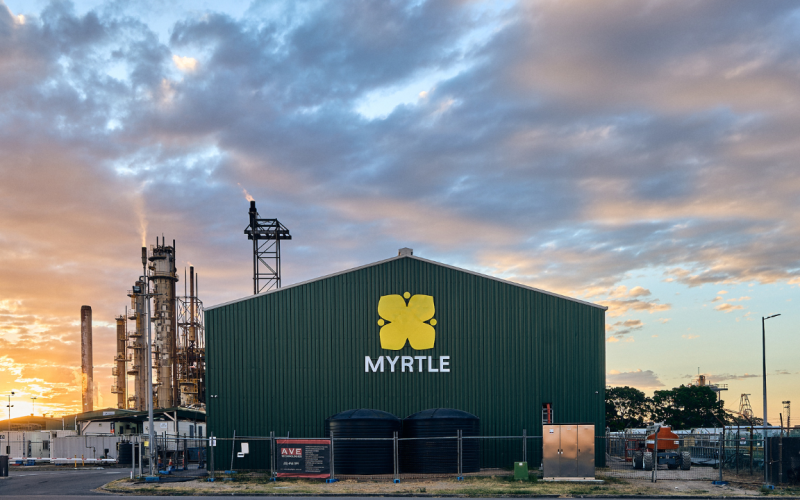
Australia has launched a facility that makes it possible to observe one of the most concrete pathways for decarbonizing industrial activities that are difficult to electrify. The Myrtle plant, developed by MCi Carbon on Kooragang Island in Newcastle, captures carbon dioxide from a neighboring Orica chemical facility and converts it into commercially usable materials.
The project operates on a key idea: some industrial emissions do not come only from energy use, but from chemical reactions inherent to production processes. In sectors such as cement, steel, mining, chemicals and materials, cutting carbon requires more than changing fuels or electrifying equipment. Technologies capable of capturing, transforming or storing unavoidable emissions are also needed.
Myrtle has an initial capacity of up to 2,500 tonnes of captured CO2 per year and an estimated production of about 10,000 tonnes of materials. It does not capture carbon directly from the air, but from a point source: Orica’s industrial ammonia manufacturing process. That integration makes it possible to turn a gaseous waste stream from one plant into an input for another productive chain.
The technology used is mineral carbonation. Captured CO2 is combined with alkaline materials rich in magnesium and calcium, including industrial by-products such as slags and mine tailings. The reaction produces stable compounds, such as precipitated magnesium carbonate, calcium carbonate and amorphous silica, which can be incorporated into different industrial processes.
The potential applications are relevant to the real economy. Calcium carbonate can be used in low-carbon concrete, paper and glass; magnesium carbonate has uses in paints and adhesives; and silica can be applied in plastics and coatings. In every case, the goal is for carbon to remain fixed in stable materials instead of returning to the atmosphere.
The scale is still small compared with global industrial emissions, but the project’s value lies in demonstrating integration. Carbon capture, mineral waste use, input manufacturing and industrial demand are connected in one model. If replicated at plants where concentrated CO2 and available alkaline residues coincide, capture can move from being seen only as a cost toward becoming a value chain.
The development received Australian public support and international private financing, including contributions from Japanese groups. That also matters: industrial climate technologies require patient capital, stable regulation, buyers willing to pay for lower-footprint materials and verification mechanisms showing how much carbon is effectively fixed.
For Fundación Argentina ASE, the Australian experience shows that the environmental agenda is not limited to prohibiting or offsetting. It also involves redesigning production processes, using waste, generating new materials and building technological capacities. In countries with mining, cement, energy, chemicals and infrastructure, decarbonization must be considered an industrial policy for sustainable human development.