
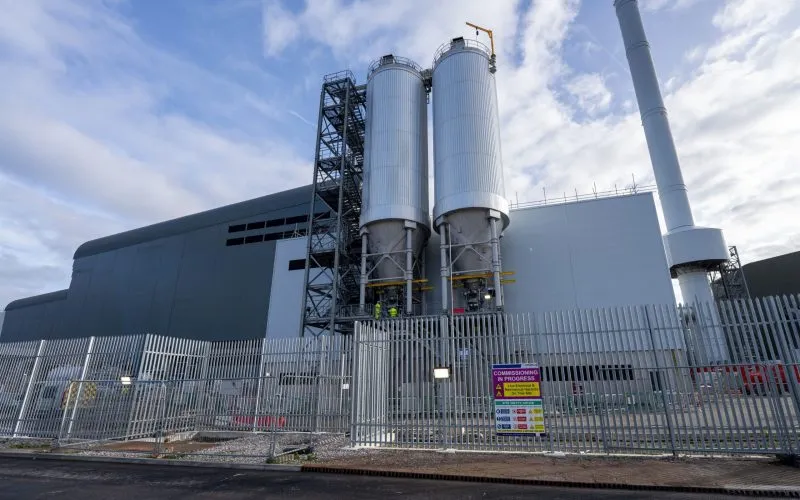
The construction of the United Kingdom’s first full-scale carbon capture facility integrated with a waste-to-energy plant has entered a new phase at the Protos project near Ellesmere Port, in Cheshire. The initiative is led by Encyclis and will be connected to the Protos Energy Recovery Facility, a plant designed to treat non-recyclable waste and convert it into baseload electricity.
The project is expected to capture around 370,000 tonnes of CO2 per year from the flue gases of the energy recovery facility. That volume will be separated through carbon capture technology and then transported through infrastructure belonging to the HyNet North West cluster to Liverpool Bay, where permanent storage is planned in depleted reservoirs beneath the seabed.
The development matters because it brings together three dimensions that are often examined separately: waste management, energy security and the reduction of industrial emissions. For Fundación Argentina ASE, this type of experience shows that environmental transition depends not only on climate targets, but also on infrastructure, regulation, financing, technical operation and coordination among public and private actors.
Protos ERF is in the commissioning phase and is designed to process up to 500,000 tonnes of residual waste per year. The plant is also expected to generate 49.9 MW of baseload electricity for the grid, recover metals and use incinerator bottom ash as an input for construction aggregates, within a broader resource recovery approach.
Carbon capture does not replace reduction, reuse or recycling of materials. Its relevance appears in hard-to-abate sectors, where residual waste streams remain that cannot be effectively recycled and where combustion produces emissions that require treatment. In those cases, environmental discussion must assess real performance, monitoring, costs, CO2 traceability and guarantees of safe storage.
Kanadevia Inova has been instructed to proceed as the engineering, procurement and construction contractor, using amine scrubbing technology applied to flue gases. The construction and commissioning programme has been set out over a three-and-a-half-year horizon, with handover expected around mid-2029.
The project is supported by the United Kingdom’s Department for Energy Security and Net Zero and forms part of the country’s strategy to deploy carbon capture and storage. It is also linked to Liverpool Bay as a transport and storage system, operated by Eni within the regional development of HyNet.
For southern, South American and emerging countries, the experience offers a methodological signal rather than a direct recipe. Industrial decarbonisation requires public capabilities, reliable data, territorial planning, robust environmental permits and a perspective that connects environment, production, employment and innovation. That is the agenda ASE considers central for discussing climate technologies seriously, without simplifications or automatic promises.