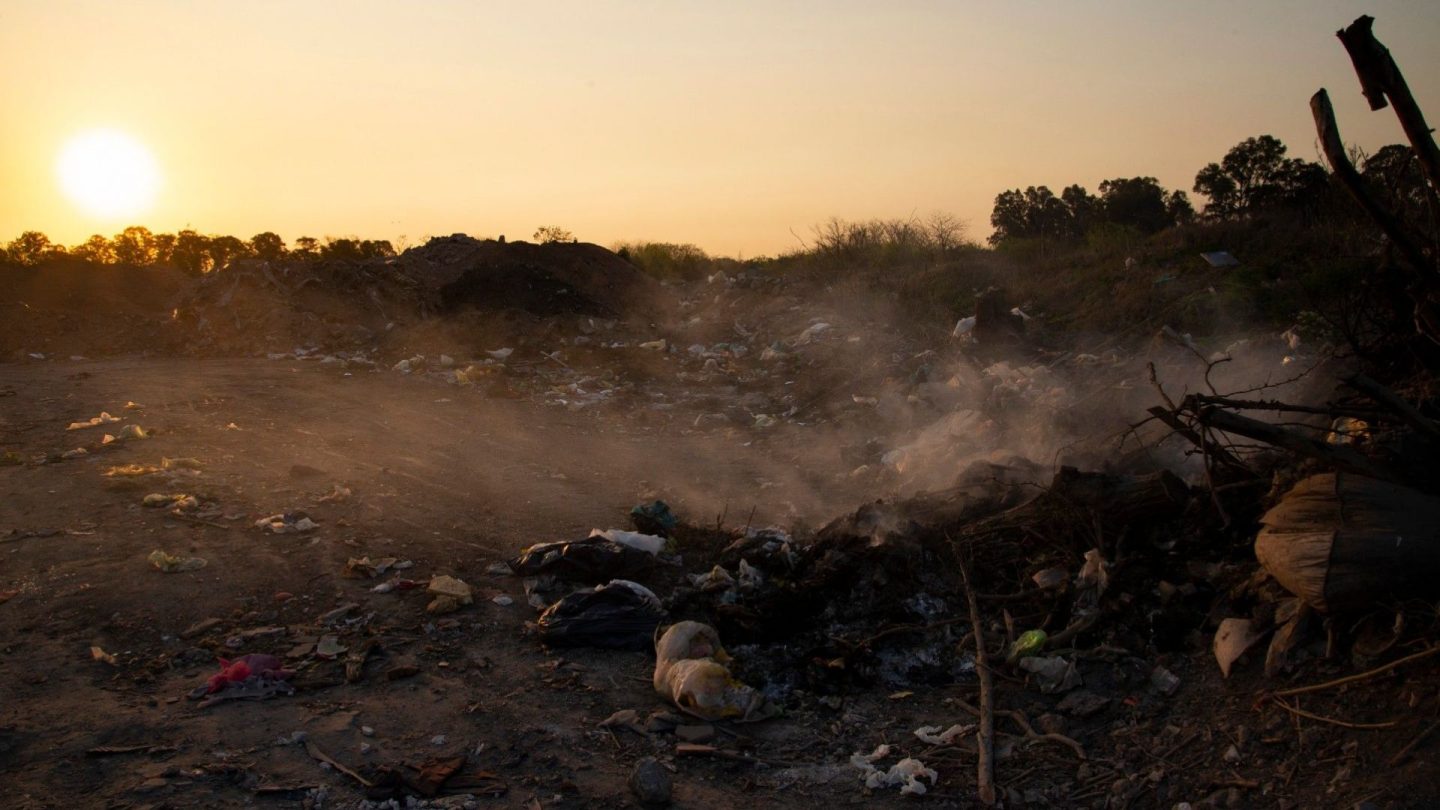
A global report by UCLA’s STOP Methane project placed Argentina at the center of an urgent environmental discussion: methane emissions from municipal waste disposal sites. The work identified the Norte III Environmental Complex in Campo de Mayo, operated by CEAMSE, as the site with the highest observed hourly methane rate in 2025 among the landfills analyzed.
The complex is located at the intersection of Camino del Buen Ayre and Provincial Route 8, in the northern area of the Buenos Aires conurbation. Around 85% of the municipal solid waste generated in the Buenos Aires Metropolitan Area is deposited there, amounting to more than 436,000 tonnes per month from the City of Buenos Aires and more than 40 municipalities in Buenos Aires province.
The measurement relies on satellite technology and public emissions data. The report analyzed nearly 3,000 methane plumes associated with 707 landfills and dumpsites in 18 countries, using instruments such as Planet Labs’ Tanager-1 and the EMIT spectrometer installed on NASA’s International Space Station. Within that framework, Norte III appeared with an average of 7.6 tonnes of methane per hour.
The figure must be read with precision. The ranking is not equivalent to a definitive annual inventory, because satellite observations depend on daytime overpasses, the availability of quantified measurements and favorable weather conditions. Even so, the study excluded sites with only one observation and considered only those detected at least twice, making the finding a relevant signal for public management.
Methane has a shorter atmospheric lifetime than carbon dioxide, but a much higher warming power in the short term. For that reason, reducing methane emissions from waste, livestock, agriculture and hydrocarbons is considered one of the fastest ways to lower climate pressure. In landfills, the gas is produced by the decomposition of organic matter under low-oxygen conditions.
CEAMSE challenged the scope of the report, noting that it is based on point-in-time satellite measurements, and defended its biogas capture, treatment and control systems. The company stated that during 2025 it began certification projects linked to biogas management under Verra’s Verified Carbon Standard, and that in April 2026 it reached 16,000 m3/h of capture, a 16% increase compared with previous values of 13,800 m3/h.
For Fundación Argentina ASE, the central point is not to turn the debate into an isolated accusation or an automatic defense of the operator, but to use the measurement as an opportunity for institutional improvement. A metropolitan region with millions of residents needs open data, continuous monitoring, emissions traceability, efficient biogas capture, reduction of organic waste sent to burial and greater integration of recycling, composting and energy recovery.
Argentina also faces a broader challenge: the persistence of more than 5,000 open dumpsites and low capture or energy use of methane across much of the system. The response cannot be technological alone; it requires territorial planning, financing, source separation, infrastructure, environmental controls and municipal capacities. Invisible methane becomes visible through satellites, but transformation depends on concrete decisions in the territory.