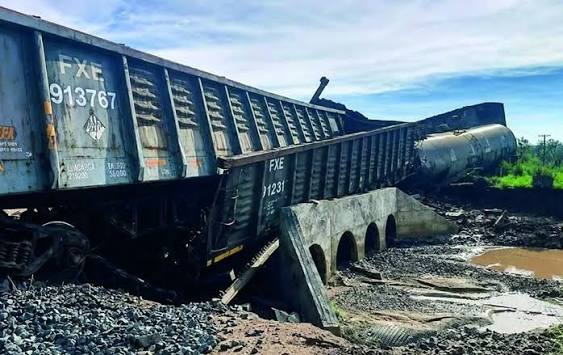
The derailment of a Ferromex freight train on the Cananea–Agua Prieta line turned a stream in Naco, Sonora, into the center of a chemical emergency. The tank car was carrying 72,000 liters of sodium hydrosulfide and approximately 70,300 liters entered the streambed. The train also carried three gondola cars containing about 240 metric tons of copper concentrate, which the company later removed under federal supervision.
The accident occurred on the night of July 25 near the Cuauhtémoc ejido, roughly 20 kilometers from the United States border. Mexico's environmental enforcement agency Profepa initially delineated 5,207 square meters of direct impact but said the potential extent can only be determined through studies. The Environment Ministry temporarily closed the site and ordered Ferromex to characterize at least three kilometers of the channel before submitting a remediation program.
Sodium hydrosulfide is a corrosive compound used in processes including mining, pulp and paper, and water treatment. Contact with water and acids can release hydrogen sulfide, a toxic gas that harms the eyes, skin and respiratory system and can cause severe injury at high concentrations. One person exposed to fumes was hospitalized in critical condition, according to health reports cited by local media and experts consulted about the incident.
Rain during and after the spill complicated containment. Barriers installed in the channel failed and flowing water moved some of the material, according to available information. Hydrologist Agustín Robles Morúa of the Sonora Institute of Technology warned that the runoff lies in the headwaters of drainage systems connected to the upper San Pedro River basin, one of the few rivers flowing north from Sonora into Arizona.
That connection does not prove cross-border contamination. As of the reporting cutoff, no official assessment had identified impacts in Arizona, nearby communities or the San Pedro River itself. The Arizona Department of Environmental Quality was nevertheless coordinating monitoring with Mexican and US agencies. Risks that must be ruled out include a slower contaminant plume in sediment and groundwater as well as acute effects on fish, arthropods and other aquatic organisms.
Profepa and the National Institute of Ecology and Climate Change collected eight duplicate soil samples and 18 arthropod-fauna samples at five locations. Drone flights covered ten kilometers without finding visible surface evidence of the product, but authorities stressed that visual absence does not exclude contamination. Inspectors verified removal of affected soil and the transfer of 1,700 liters left in the tank; laboratory results will determine what must be removed, treated or restored.
Ferromex's obligation extends beyond visible cleanup. The company must remove contaminated railcars and infrastructure, document the work, submit the characterization and carry out an authority-approved plan. Sonora communities are demanding transparency because of the 2014 Sonora River spill, although the incidents differ in substance and scale. The decisive next evidence will be soil, water, biota and subsurface results, followed by a public program that allows verification of remediation and any redress for affected people.