

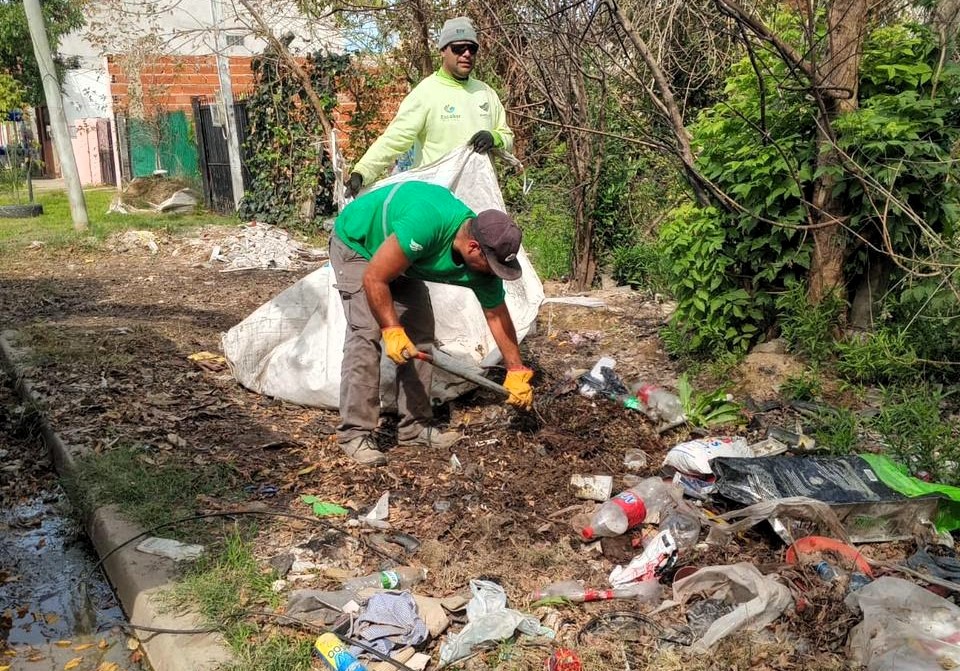
Escobar has released an environmental balance that frames urban cleanliness as more than a waste removal operation. Between late March and July, the municipality recorded 1,056 complaints and interventions involving illegal dumping sites across the district and reported 769 fully resolved cases, equivalent to a 72.8% effectiveness rate. During weeks of stronger tactical deployment, the response reached peaks of 88.5%, according to the Secretariat of Territorial Planning and Public Space.
The figure matters because small illegal dumping sites are not only a visual problem. They create local contamination, degrade public space, clog ditches, interfere with watercourses, attract pests and weaken urban drainage when heavy rains arrive. In a district that combines consolidated neighborhoods, expanding urban areas, wetlands and peri-urban corridors, each illegal disposal point operates as a small risk system that can grow if it is not interrupted quickly.
The municipal operation covered every locality in the district, with the largest workload concentrated in Belen de Escobar, Garin and Ingeniero Maschwitz, and daily interventions in Maquinista Savio, Matheu, Loma Verde and 24 de Febrero. That geography shows that the problem is not confined to a single hotspot. It reflects a dispersed network of urban habits, informal waste disposal, private conduct and pressure on edges where everyday environmental management is harder to sustain.
Verónica Sabena, the secretary of Territorial Planning and Public Space, linked the clean-up effort to a broader preventive strategy. She said the municipality reinforced maintenance of ditches and watercourses under the planning ordered at the start of the year in response to the El Nino phenomenon, with drainage as a central objective. But she also underlined the operational limit of any public policy: if residents or private operators keep dumping waste in public areas, eradication becomes a permanent race against recurrence.
The current stage combines crews, logistics, territorial control and neighborhood reporting. Tools such as Ojos y Oidos en Alerta and the Flora chatbot work as distributed sensors, allowing residents to report new waste hotspots in real time. The strategic rationale is direct: the sooner a dumping site is detected, the lower the environmental, health and operational cost of removing it; the longer the response takes, the more likely the site is to consolidate and attract further dumping.
The real next step should be to measure not only how many sites are cleaned, but how many do not reappear. A 72.8% effectiveness rate is a meaningful advance, yet the decisive indicator will be recurrence reduction by locality, identification of offenders, better access to formal waste disposal and continuity in drainage maintenance. If Escobar turns rapid response into sustained prevention, the removal of illegal dumping sites can move from an emergency urban operation to a stable environmental policy.