
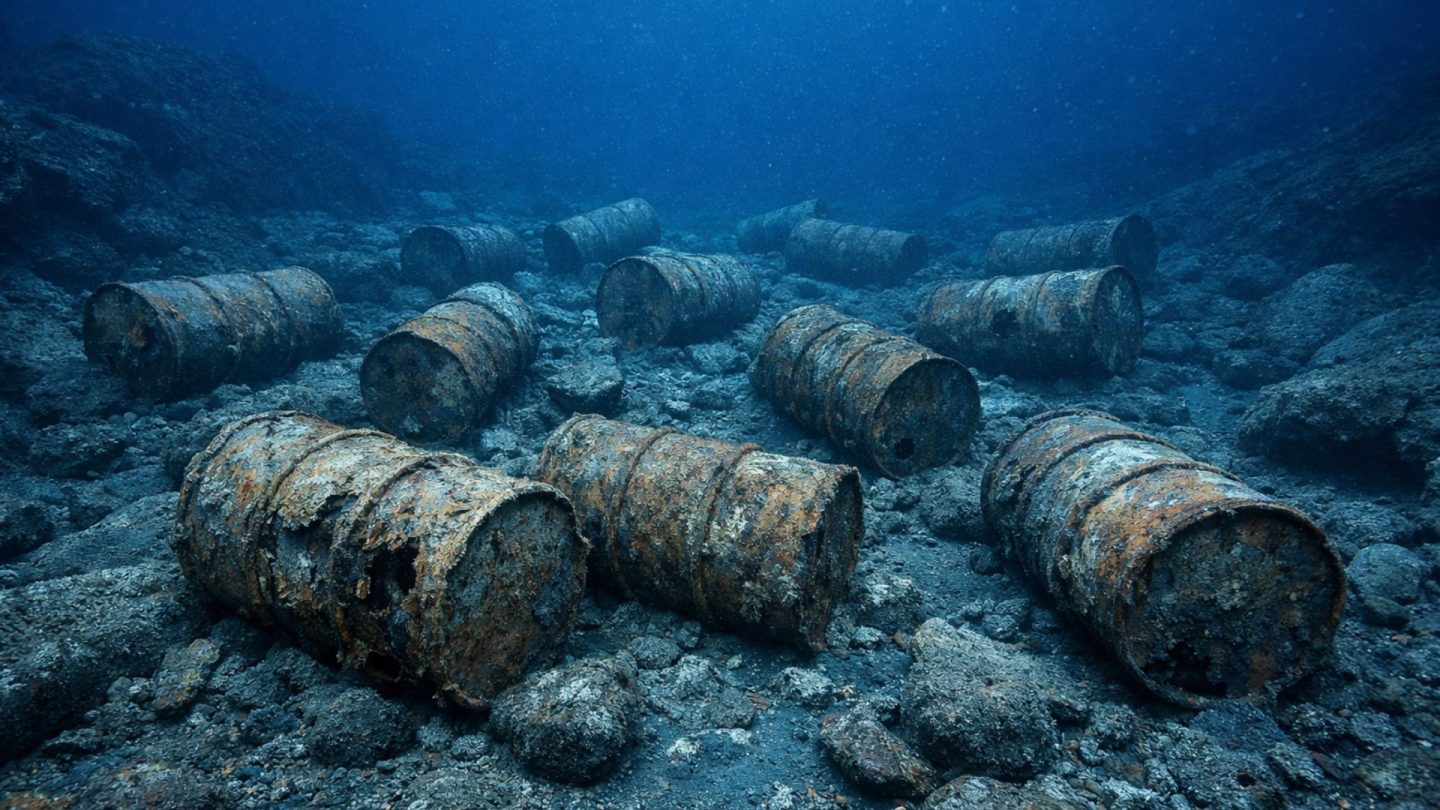
Research by the Scripps Institution of Oceanography detected highly alkaline waste around barrel-like objects deposited in deep water off Southern California. The containers form part of a legacy of decades of dumping and were located between the Palos Verdes Peninsula and Santa Catalina Island using sonar and remotely operated vehicles.
From the 1930s through the 1970s, at least fourteen offshore areas were designated to receive varied materials, ranging from refinery sludge to radioactive waste. The later withdrawal of dumping permits ended the authorized practice but did not remove what had accumulated. The objects remained on the seabed, and the contents of most individual containers are still unknown.
Researchers focused on white halos visible around some barrels. Because the region also carries extensive DDT contamination, the markings were initially suspected of being connected to that chemical. Analyses begun in 2021 by a team led by microbiologist Johanna Gutleben found a different explanation: extremely alkaline waste that had chemically transformed the sediment.
Measurements recorded pH near 12 around the containers, compared with about 8 in seawater. The caustic setting restricts local life and supports low-diversity microbial communities adapted to extreme conditions. Mineral analysis identified brucite, a magnesium hydroxide formed when alkaline waste reacts with magnesium in seawater.
That reaction explains the halos and shows that the chemical footprint persists half a century later. It does not, however, establish that every object is a confirmed source of radiation. The historic dumping grounds received different mixtures, while the reported finding concerns alkaline contamination. Separating those hazards prevents the general history of the sites from being confused with what was actually measured in the studied barrels.
Only a small sample was examined, and roughly one third of those containers displayed halos. The true frequency of the waste, its spread across the seabed, effects on larger organisms and any movement into the food chain therefore remain open questions. The PNAS Nexus study identifies a mechanism and a visible signal, but it is neither a complete inventory nor a final ecosystem assessment.
Intervening at deep-sea dump sites poses technical and environmental difficulties, so immediate work centers on mapping, sampling and monitoring. Next steps need to compare barrels with and without halos, broaden biological analysis and determine the material at each hotspot. That evidence will be required before deciding whether waste should be isolated, removed or monitored in place without causing further dispersal.