
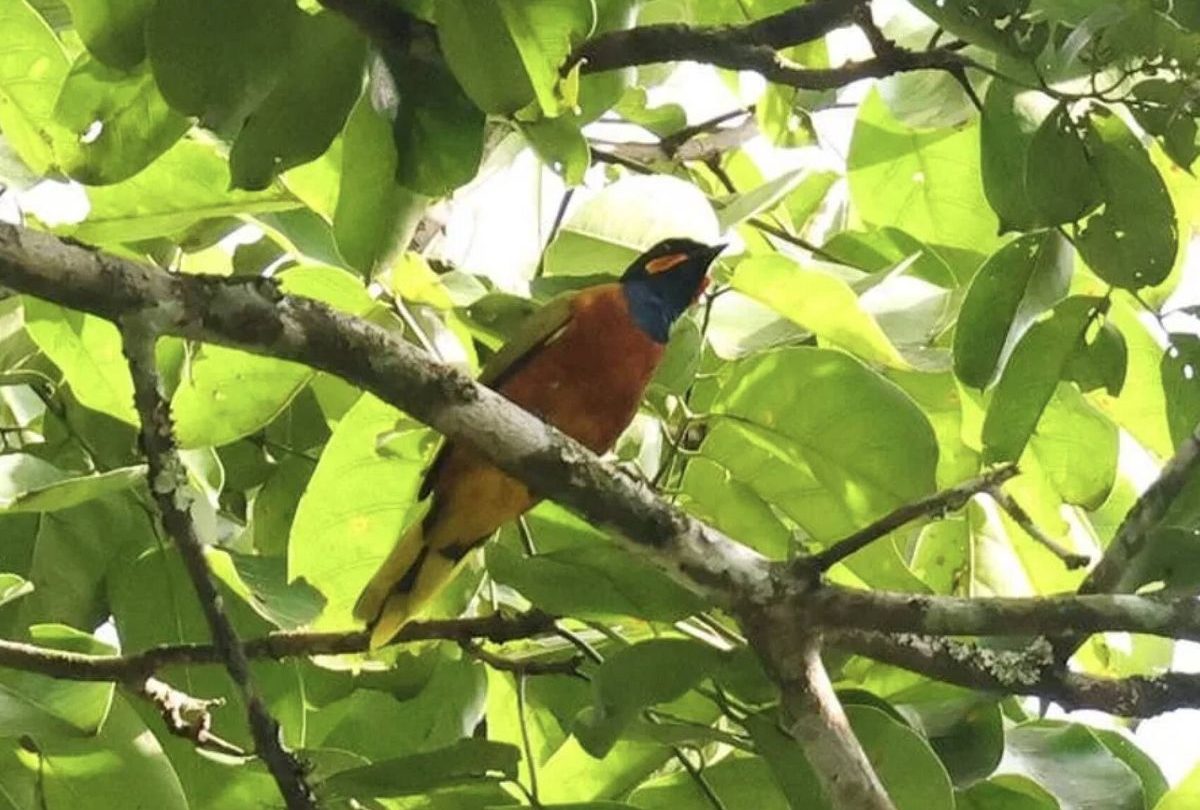
A photograph from the canopy of Côte d’Ivoire's Taï National Park confirmed a Ghana cuckooshrike after 13 years without a verified record. Stephanie Bartlett captured the image as Paulo Ditzel tracked the bird during an International Bird Conservation Partnership survey. It proves presence, not population recovery.
Lobotos lobatus was last documented in Ghana's Atewa Forest in 2013. Its presumed range crosses Upper Guinean rainforest from Guinea and Sierra Leone to Ghana. A canopy-dwelling and elusive bird can remain undetected even where it survives.
The camera served as a scientific instrument. Images of its orange body and black-and-yellow wings, along with what may be the first video, enabled identification. Months of surveys and indispensable work by West African researchers made the brief encounter possible.
Search for Lost Birds listed the species because it lacked scientific documentation for over a decade. “Lost” does not necessarily mean extinct; it can reflect rarity, poor survey coverage or inaccessible canopy. One record leaves abundance, breeding, connectivity and trend unknown.
The IUCN lists the bird as vulnerable. Logging and agriculture have reduced and fragmented likely habitat. Taï protects a major Upper Guinean forest block but faces artisanal gold mining and illegal hunting, so one protected observation point is not enough.
Targeted acoustic recorders, cameras, repeated transects and habitat models can seek more birds without publishing sensitive coordinates. Evidence of pairs, juveniles or calls would clarify breeding, while diet and tree-use studies could identify resources requiring protection.
The sighting turns uncertainty into a measurable agenda. Rangers and communities need resources against mining and hunting, and scientists should report methods and unsuccessful searches. A photograph reopens a conservation opportunity; sustained habitat protection will determine whether the population is secure.