
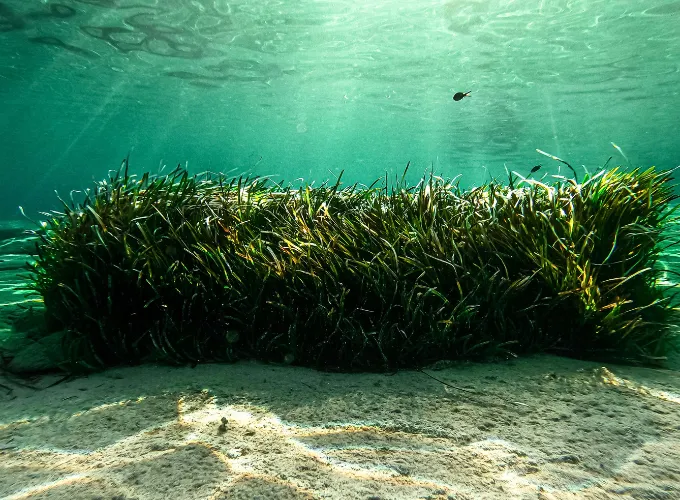
Ocean Visions launched a digital roadmap designed to bring structure to the discussion on seaweed as a potential climate solution. The tool, called Seaweed-Based Products for Decarbonization, seeks to identify scientific, technological, economic and public policy priorities for the responsible development of seaweed-based products that could reduce emissions across different sectors.
The initiative starts from a concrete premise: seaweed can replace fossil-based ingredients or inputs in certain products and, unlike several conventional alternatives, can grow without requiring large inputs of freshwater, agricultural land or fertilizers. That potential advantage does not remove the need to measure impacts, scaling capacities and environmental production conditions.
The roadmap is organized around five sectoral opportunities: agricultural uses, biomaterials, critical minerals, food products and animal feed, and biofuels. In each case, the approach is not limited to describing market possibilities; it also incorporates scientific readiness, engineering and production challenges, financing barriers, regulatory conditions and social and environmental considerations.
The digital document also recognizes that seaweed aquaculture is already a significant global activity, especially in food and hydrocolloids. However, moving seaweed products toward larger-scale climate applications requires productive expansion, more refined technologies to cultivate, harvest and handle biomass, and systems capable of ensuring traceability and environmental performance.
For Fundación Argentina ASE, the value of this tool lies in the way it organizes a discussion that often swings between technological enthusiasm and environmental distrust. Ocean biomass-based solutions may open opportunities, but they require governance, data, ecosystem assessment and territorial-use criteria that prevent unwanted impacts on coastal communities and marine systems.
The roadmap was developed with contributions from an advisory board that included Ling Cao of Xiamen University; Peter Green of Hatch Blue; Rod Fujita, formerly associated with the Environmental Defense Fund; and Simon Freeman of Wetstone, formerly linked to the ARPA-E Mariner program. That composition shows the need to connect research, investment, environmental experience and technological development knowledge.
Ocean Visions presents the resource as an evolving tool that will be updated as science, technology, markets and policies linked to the seaweed sector advance. That condition matters: in emerging areas, information changes quickly and responsible decisions depend on reviewing assumptions, validating results and correcting trajectories.
For southern, South American and emerging countries, the seaweed and ocean agenda invites a focus on building local capabilities rather than importing ready-made formulas. The discussion should integrate marine biodiversity, coastal development, sustainable production, employment, environmental monitoring and innovation. At that intersection, ASE identifies a strategic conversation: how to use ocean knowledge to promote climate solutions that are technically viable, socially legitimate and environmentally careful.