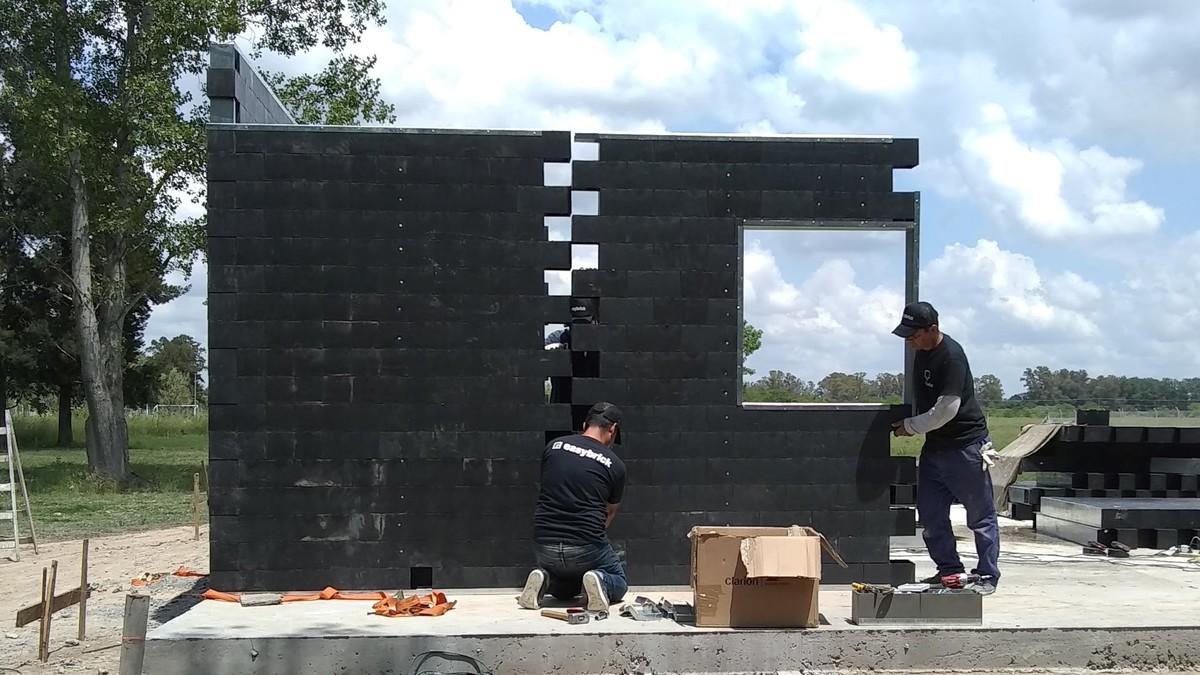
A technology developed in Colombia turns post-consumer plastic into blocks and columns assembled as a modular system. Conceptos Plásticos says a small home can be erected in about five days by a small team because the interlocking components simplify construction and reduce the need for wet mixes and heavy machinery.
Architect Óscar Andrés Méndez and engineer Isabel Cristina Gámez founded the company in 2010. Its approach integrates waste sorting, industrial transformation and component design for homes, schools and community facilities. The product is not a conventional brick: it is a system that must be designed, calculated and assembled as a complete structure.
Conceptos Plásticos reports that its projects exceed 40,000 square meters built and delivered to vulnerable communities in Latin America and Africa. It also lists productive implementations in Colombia, Brazil, Côte d'Ivoire, South Sudan and Puerto Rico. These are company-reported figures that describe accumulated experience, not an independent environmental-impact assessment.
The model's circular value lies in giving long-term use to plastic that might otherwise reach dumps, waterways or informal burning. To make that benefit real, the process must separate incompatible materials, control composition and additives, ensure consistent quality and prevent the final product from releasing contaminants during use.
The UNICEF partnership in Côte d'Ivoire provides a public-use reference. Since 2019, a factory initiative has converted local plastic waste, excluding PVC, into blocks for classrooms. The program projected hundreds of classrooms and industrial capacity of up to 9,200 tons a year, alongside women-led collection systems.
Fast assembly does not replace safety requirements. Each project must verify structural strength, fire and ultraviolet performance, thermal comfort, ventilation, additive toxicity and compliance with local codes. It must also plan repair, disassembly and the destination of components when the building reaches the end of its service life.
The system offers a practical route linking waste management, industry and housing, but it cannot replace housing policy or solve plastic pollution alone. Legitimate scaling requires life-cycle data, material traceability, fair integration of waste pickers, technical certification and transparent public procurement. Innovation is sustainable only if it keeps plastic controlled and buildings safe throughout their life.