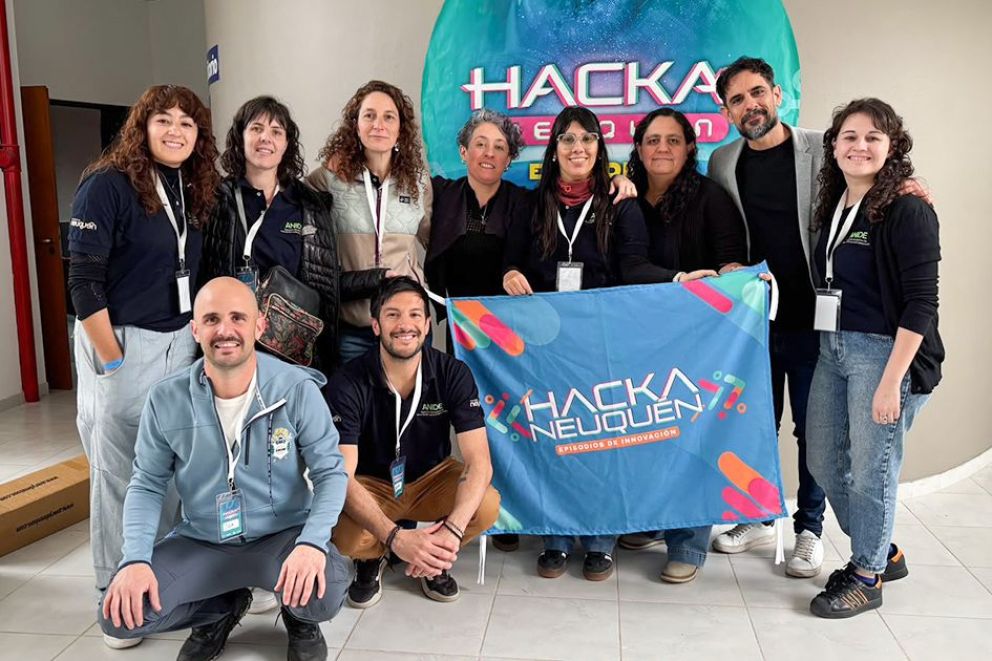
The interdisciplinary Zorros Patagónicos team won HackaNeuquén Episode III with Eco-Terrazo Loncopué, a proposal to turn discarded glass into construction materials within the town. The project scored 92.18 points in the 22 August final at the National University of Comahue and addressed a concrete challenge in municipal waste management.
Guillermo Chávez, Joaquín Chávez, Camila Tolosa, Alexis Luciano Vargas Tupa and Martina Dinamarca brought together chemical engineering, nursing, architecture, petroleum engineering and medical sciences. Four of the 17 finalist teams chose the provincial and municipal challenge: transforming glass into a resource without moving it out of Loncopué. The group's diversity connected technology, health, design and production.
The obstacle is economic as well as environmental. In Neuquén towns far from industrial plants, recovered glass is heavy and has little market value, so transport can cost more than the sale. Material remains stored for long periods, loses recovery options or returns to final disposal. Conventional melting requires furnaces, energy and infrastructure that are difficult to sustain locally.
Eco-Terrazo would sort and cold-crush the glass without heating it to melting point, then incorporate it into cement-based matrices. The mixture could make tiles, cladding and pieces for sinks or basins. This route cuts transport and avoids the thermal stage of traditional recycling, but it is not impact-free: cement, crushing, water and finishes consume resources that must be counted.
The model is designed for community ownership through local cooperatives and Vocational Training Centre No. 8. If it works, waste becomes an input for valuable products and can create green jobs in sorting, processing, design, manufacture and sales. Genuine inclusion will require paid training, safe work, clear ownership of equipment and transparent distribution of revenue.
Before scaling, a pilot must resolve technical and health risks. It needs controls for sharp fragments and respirable dust, separation of ceramics, metals and incompatible glass, and tests of strength, absorption, abrasion, adhesion and durability. Products must meet building standards and show they do not release hazardous substances; life-cycle analysis should compare energy, emissions and costs with conventional materials.
The award opens a post-hackathon stage in which ANIDE and participating institutions plan to support development. Core indicators are tonnes diverted from disposal, unit cost, energy use, transport kilometres avoided, product performance, sales and stable local jobs. If technical and commercial validation confirms the concept, Loncopué can turn a logistics disadvantage into a circular chain replicable in other Patagonian towns.