
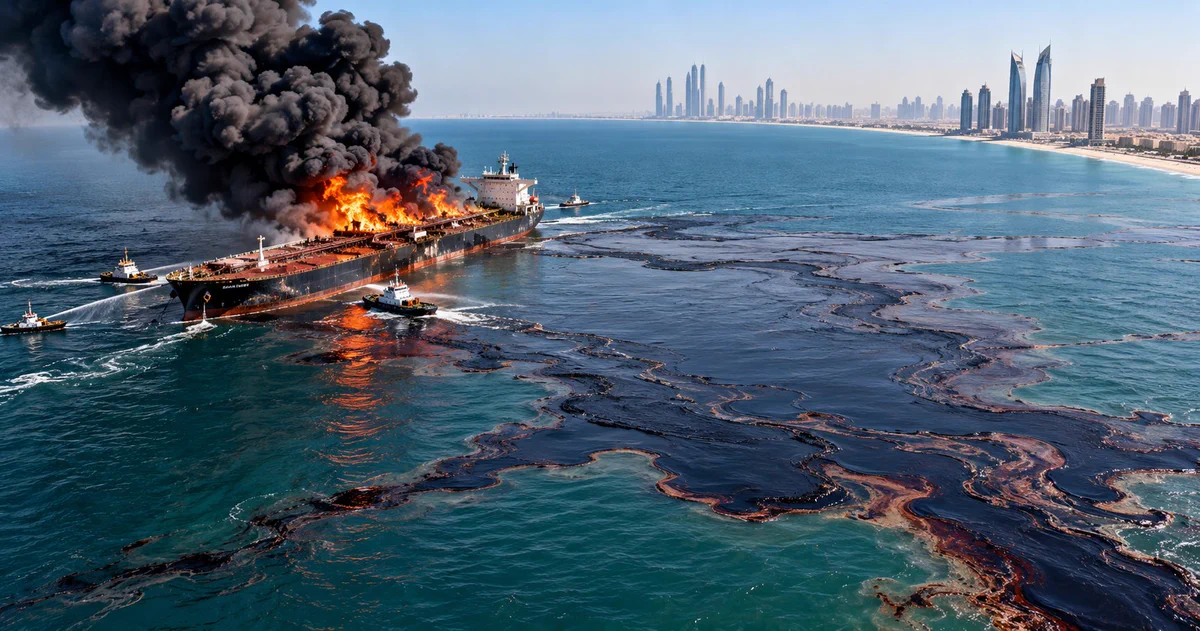
The United Arab Emirates says the Gem No.2 tanker leak has been stopped and no new discharge detected. This changes the emergency phase without ending it: federal and local teams continue cleanup, sampling and surveillance of a slick concentrated off Umm Al Quwain and extending partly towards Ras Al Khaimah, Ajman and Sharjah.
The environment ministry reported a marked decline in the density of marine pollution. That is evidence of improvement, not proof that all oil has disappeared. Hydrocarbons may persist in sand, sediment, mangroves and organisms after the surface sheen breaks apart, requiring water, shoreline and wildlife tests.
Some beaches and coastal areas remain closed as a precaution. Officials stress that closure does not confirm pollution at every site; it can also prevent exposure, preserve access for crews and allow for changing winds and currents. Reopening should follow published thresholds and repeated sampling rather than sight alone.
Technical teams repaired damaged components, restored some operating systems and are assessing the tanker's structural integrity and safest handling. Shipping sources said a projectile hit the vessel on October 9 and started a fire that was extinguished, but authorities have not publicly confirmed the incident's cause.
The government says fish and food in markets are safe and measures to protect drinking water will not disrupt supply. This matters because desalination provides more than 80% of potable water and coastal intakes may need shutdowns if oil approaches, although no plant closure has been announced.
Key data are still missing: spilled volume, oil type and thickness, verified affected area and laboratory findings. Without them, impacts on birds, turtles, fish, seagrass and fisheries cannot be quantified or reliably compared with earlier Gulf spills.
Stopping the source and seeing lower pollution reduce immediate risk, but recovery requires verifiable trends. Priorities are safe waste removal, protection of intakes and habitats, control of the vessel, and public maps and reopening criteria. This is an important operational advance, not completed remediation.