
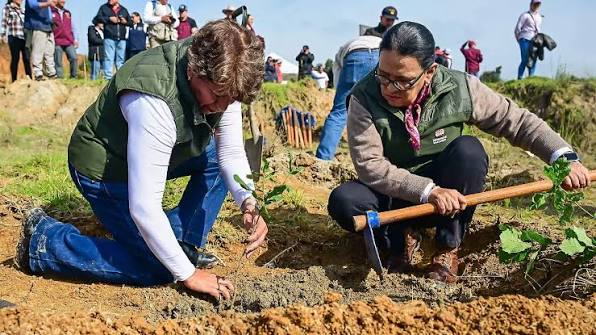
Baja California Sur joined Mexico's 2026 National Reforestation Day with a target of 125,559 plants across 831 hectares in the municipalities of La Paz and Comondú. The state launch took place in the El Rosario ejido, where authorities, residents and public employees planted 300 specimens adapted to regional conditions.
The initial selection included mesquite, cardón cactus, lomboy and palo Adán, native species associated with arid and semi-arid ecosystems. Their use avoids treating reforestation as a copy of humid-forest models. In a territory with scarce water, high temperatures and irregular rainfall, matching each plant to the soil, site and season is crucial for survival.
Official information describes the event as the start of a broader program. Beyond El Rosario's 300 plants, an initial phase calls for another 2,550 in the La Paz watershed, while work was carried out simultaneously in Comondú. The difference between those quantities and the overall target must remain clear: 125,559 is the projected objective, not a completed planting balance.
The plan associates reforestation with biodiversity, soil protection, and climate adaptation and mitigation benefits. Those effects are possible but not automatic. They depend on plants becoming established, growing and forming functional vegetation communities. Reforestation must also avoid replacing protection for mature vegetation or altering ecosystems that are naturally open.
In drylands, work after planting often determines the result. Protection from grazing, replacement of losses, invasive-species control, establishment watering where appropriate, and monitoring over several seasons are essential tasks. Counting plants distributed or placed measures effort, but survival after one, two and three years is a better indicator of actual restoration.
The event brought together federal and state governments, the National Commission of Natural Protected Areas and community participants. Environmental defenders in the state were also formally appointed. Such participation can expand local capacity if it is translated into defined responsibilities, maintenance resources and public access to the location and progress of intervention sites.
The challenge across 831 hectares is to move from a visible mobilization to a verifiable policy. Maps of sites, species and planting densities, dates, water availability and periodic survival rates would show which techniques work in La Paz and Comondú. Publishing those data would distinguish a planting campaign from a sustained ecological restoration process.