
Wind-turbine blades are the difficult link in wind-energy recycling. About 90–96% of turbine weight already has conventional routes through tower steel, cable copper and nacelle metals. Blades combine glass fibre, epoxy, wood, adhesives, coatings and foam in a cured structure that cannot be remelted and separated like thermoplastic.
The challenge grows as early fleets age. Onshore blades often retire after 20–25 years, and Japan expects 2,000–2,500 tonnes annually in the 2030s, roughly 100–200 turbines. Size drives cost: a V80 blade is about 39 metres and 6.5 tonnes, while offshore designs are much larger.
Cement co-processing is the most established route. Shredded resin supplies kiln energy and mineral fibre replaces sand or clay. GE and Veolia modelled roughly 90% weight reuse and 27% lower cement-process CO2 in their case. It is not closed loop: fibre strength is destroyed and resin carbon is emitted.
Japan's Shimizu and Otaki Shoten announced a route that cuts, crushes and moulds composite into a steelmaking carbon additive, aiming to keep carbon in steel and displace coke. It is promising corporate evidence, but independent papers, plant-scale results and full lifecycle assessment are not yet public.
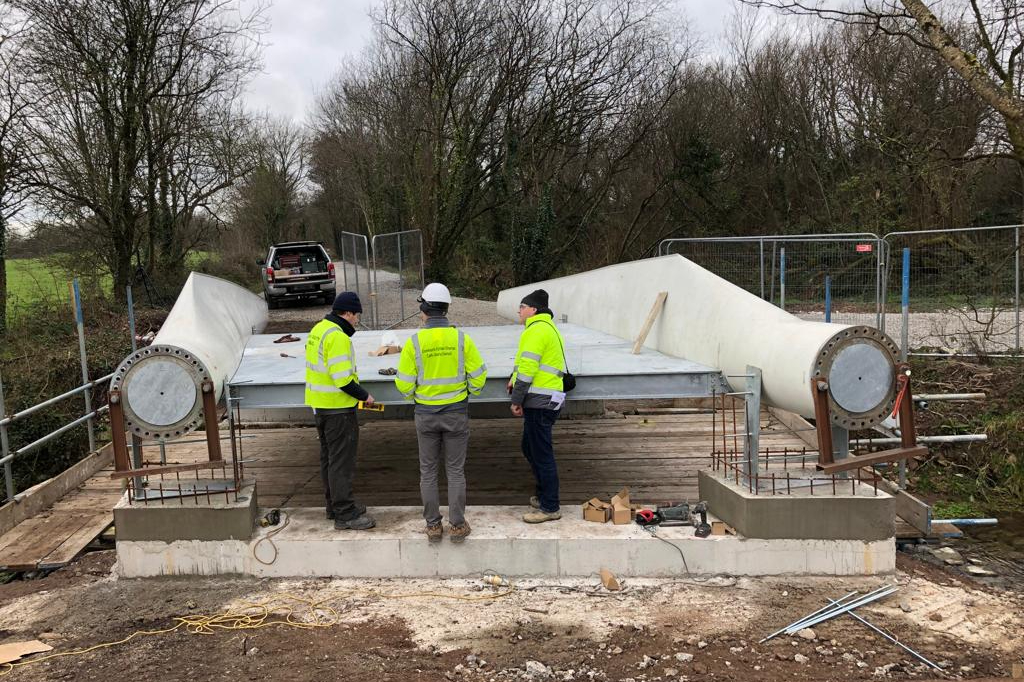
Whole reuse preserves strength. Britain's HS2 tested sections as concrete reinforcement in low-stress uses, claiming up to 90% lower emissions for reinforcement only. In the Netherlands, two blades and a section form a 60-metre A58 noise barrier performing like concrete, with cost and safety monitoring through 2026.
A visible reuse turns nacelles rather than blades into shelter. The Nestle prototype converted a 19-year-old Vestas V80 nacelle into a 35-square-metre solar micro-home. It proves creative value, but one building absorbs one unit and transport limits mass impact.
No route is universal. Cement and steel accept volume but destroy structural value; reuse preserves it but needs proximity, engineering, certification and bespoke demand. The deeper answer is design for disassembly through separable resins, material passports, take-back contracts and producer responsibility, measured by traceability and net emissions.