A study published in Conservation Letters warns that the expansion of offshore oil exploration along Brazil’s Equatorial Margin may increase significant risks for marine conservation. The research examined a region that includes the Amazon coast and combines high ecological value, still incomplete scientific knowledge and growing industrial pressure.
The paper, titled Projected Risks to Biodiversity Conservation Along Brazil’s Equatorial Margin Under Expanding Offshore Oil Development, was authored by Rafael A. Magris, Martinho Marta-Almeida and Carlos Alessandre Domingos Lentini. Its approach integrates oceanographic modeling of potential spill trajectories, habitat distribution and vulnerability scores to estimate cumulative risks across different sedimentary basins.
The warning is not focused on a single drilling point or an isolated event. The study argues that environmental assessment must consider the sum of possible exposures when operational, exploratory and prospective blocks expand across a broad marine system. That cumulative perspective is essential for ecosystems connected by currents, fisheries, biological routes and coastal dynamics.
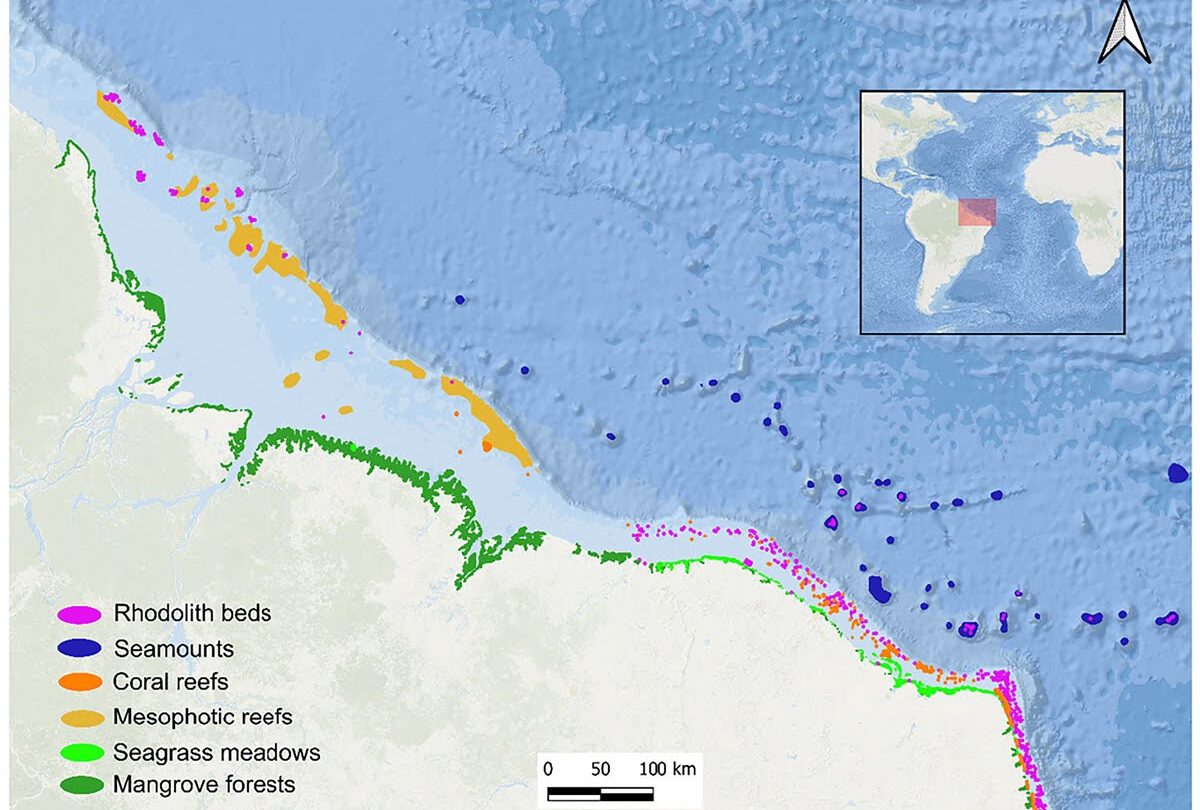
Potentially affected habitats include seagrass meadows, mangroves, rhodolith beds, coral reefs, mesophotic reefs and seamount ecosystems. The authors identify the Potiguar Basin as contributing most to cumulative risk for seagrass meadows, rhodoliths, reefs and seamounts, while in Foz do Amazonas overall risk appears comparatively lower, although planned activities increase projected exposure for mesophotic reefs.
The region is especially important because of its connection with the Amazon plume, deep reef systems, coastal mangroves and habitats that support biodiversity, coastal protection, carbon sequestration, fisheries and local livelihoods. The study also recalls the oil spill that affected Brazil between 2019 and 2020, reaching around 2,900 kilometers of coastline and showing how even relatively moderate releases can generate extensive ecological, social and economic impacts.
The issue does not allow for simple answers. Brazil faces a tension familiar to many emerging countries: expanding energy resources, sustaining revenues and infrastructure, and at the same time meeting climate and biodiversity commitments. For Fundación Argentina ASE, the critical point is not to automatically reject all productive activity, but to require robust information, rigorous permits, permanent monitoring, emergency preparedness and marine spatial planning before advancing into sensitive areas.
The study also recognizes information and modeling limitations, which reinforces the need for more research. The simulations used represent exposure trajectories driven by currents and winds, but they do not replace specific spill assessments, release conditions, oil chemistry processes or higher-resolution three-dimensional models. Under uncertainty, environmental governance must act with caution and must not treat data gaps as absence of risk.
Suggested measures include strengthening ecological monitoring, improving spill preparedness and expanding marine protected areas, especially where conservation priorities overlap with risk zones. For the southern, South American and emerging agenda, this case underscores a strategic lesson: energy development requires anticipatory environmental planning, state capacities and dialogue with coastal communities, because marine biodiversity is also infrastructure for life, work and territorial resilience.