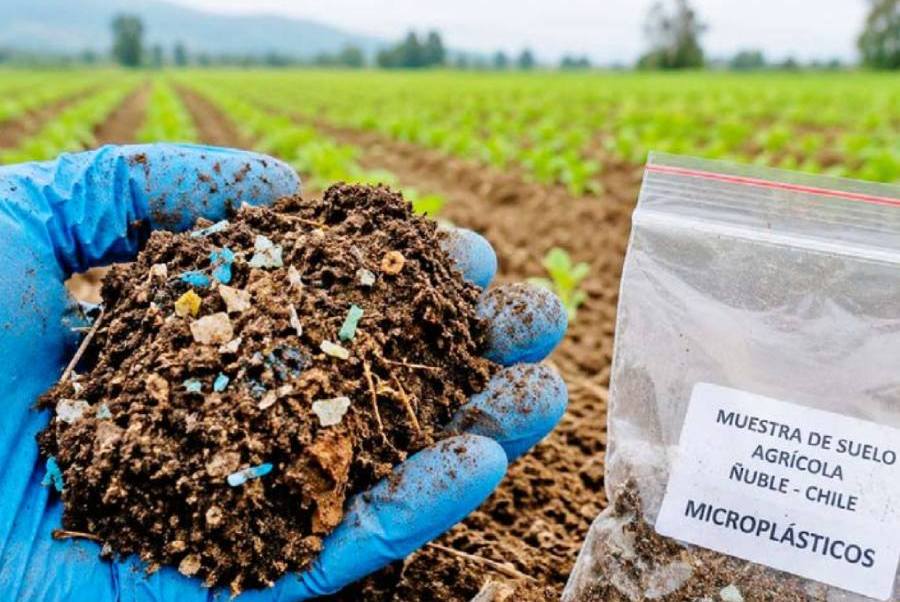
The accumulation of microplastics in farmland is an emerging threat to UK food security, according to a new report from the all-party parliamentary group on microplastics. The study was produced with the University of Portsmouth’s Revolution Plastics Institute and the Women’s Institute. It warns of a growing risk to fertility and production, not a nationwide crop loss already measured and attributed solely to these particles.
British agricultural soils rank among Europe’s most contaminated. Repeated spreading of sewage sludge as fertilizer is a major route: sludge recovers nutrients and organic matter, but can also move particles that wastewater treatment does not fully capture. Tyre wear, synthetic textiles, paint, packaging, cosmetics, agricultural plastics and the fragmentation of products across their lifecycle add further releases.
The report defines microplastics as particles from one micrometre to five millimetres and nanoplastics as smaller than one micrometre. The distinction matters because the smallest particles can cross biological membranes and are especially difficult to detect. The absence of standardized soil sampling and measurement methods still prevents a comparable national baseline.
Evidence submitted to the inquiry identifies several damage pathways. Particles may change soil structure and water-holding capacity, disrupt communities of essential bacteria and fungi, and enter organisms such as earthworms, where physiological changes have been observed. Together these effects can weaken functions supporting plant growth, especially as drought, floods and heatwaves already pressure farming.
Plastic is not chemically neutral. The report notes that more than 16,000 chemicals are used in plastics, about 4,000 of them known to be hazardous to health, while many others lack adequate testing. Particles can also carry heavy metals, bacteria, viral material and other environmental contaminants. Risk varies with polymer, size, concentration, additives, soil and exposure, so it cannot be reduced to one number.
The five proposed policy lines are legally binding reduction targets, regulation of the largest sources, extended producer responsibility across the lifecycle, stronger wastewater, sludge and soil protections, and a coordinated national evidence and monitoring system. This approach shifts effort from cleaning up after release toward preventing particles at source.
The practical priority is to measure flows and accumulation before uncertainty becomes an excuse for delay. Concentrations by soil type, sludge content, microbial health, infiltration, soil-fauna activity, yields and occurrence in crops would reveal trends and regulatory performance. Protecting soil requires lower emissions and modernized sludge controls while retaining useful nutrients and avoiding replacement of one waste problem with another.