
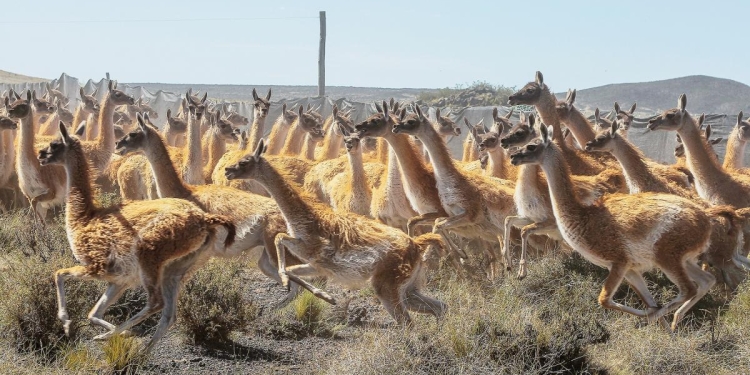
The image of the guanaco is part of the Patagonian landscape. A symbol of native fauna and an undisputed protagonist of the steppe, for decades it was considered a conservation emblem. However, for biologist and rural producer Stuart "Chacho" Blake, the uncontrolled growth of this species could be pushing Santa Cruz towards an environmental crisis with far-reaching consequences.
According to his estimates, the guanaco population in the province would have gone from around 600,000 at the beginning of the 1990s to around 2 million today. The problem, he assures, is not only productive. His warning points to a much more serious scenario: the irreversible degradation of grasslands and the advance of desertification over millions of hectares of the Patagonian steppe.
For centuries, the guanaco population was regulated by natural factors: water availability, harsh winters, predators, and the presence of indigenous peoples. But in recent decades, those limits have disappeared. The expansion of livestock infrastructure incorporated thousands of artificial water points in fields where there were previously only a few natural watering holes. Added to this were milder winters associated with climate change, a sharp contraction in sheep farming, and the abandonment of numerous rural establishments. "Abandoned fields have water, but they no longer have management. They are ideal places for the multiplication of the guanaco," Blake explains.
Blake's concern began to take shape at the end of 2023, when he decided to consult specialists from the University of St. Andrews in Scotland, an international reference in ecological modelling. He presented the Santa Cruz case to a panel of mathematicians, ecologists and zoologists. "The first reaction was one of surprise. They did not know the magnitude of the territory or the characteristics of the province. But then they told me something that stuck with me: if the conditions you describe are correct, this could become an ecological disaster," he recalls. Since then, he began to publish a series of analyses known as "Los Guanaco Papers", in which he argues that the discussion about the species must incorporate population management tools used in other countries.
The expansion of the guanaco coincides with decades of decline in sheep farming in much of Patagonia. Blake clarifies that the sector's crisis has multiple causes: the international fall in the price of wool, the eruption of the Hudson volcano, changes in international markets, and long-term economic transformations. However, he considers that competition for the region's scarcest resource — grass — has become a determining factor. "When the number of guanacos increases, the producer has to reduce the sheep stocking rate. It goes down 10%, 20%, 30%. It reaches a point where the operation is no longer viable," he argues.
The main alarm is linked to the ecological behaviour of the species. Blake argues that the guanaco is an extraordinarily resistant animal, adapted to survive in extreme conditions. This capacity means that natural population regulation mechanisms act too late. "The guanaco does not rapidly reduce its reproduction when the resource decreases. It continues until the grassland is already seriously degraded," he explains. In a province characterised by fragile soils, strong winds and low rainfall, the loss of vegetation cover can trigger erosion processes that are difficult to reverse.
One of the points that most concerns the researcher is the lack of updated information. The last comprehensive survey published on the guanaco population in Santa Cruz would be more than a decade old. "The first step is to know how many animals there really are. We need a scientific, open, replicable census carried out on the scale of the entire ecosystem," he states. The absence of precise data hinders any serious planning to reconcile conservation, production and environmental protection.
Far from proposing the eradication of the species, Blake proposes moving towards population management schemes similar to those used in countries such as Australia, Norway or Scotland with other emblematic wild species. Among the alternatives, he mentions the possibility of developing markets for guanaco meat, fibre and leather, generating economic incentives that allow populations to be kept within levels compatible with the carrying capacity of the steppe. "The challenge is to find a balance. If we do not manage to control growth in a sustainable way, the risk is that we will end up losing what we want to protect: the Patagonian grassland," he concludes.