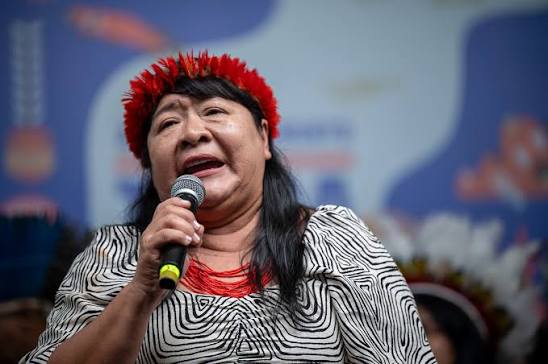
The largest Indigenous representation yet achieved in Brazil's Chamber of Deputies is trying to turn a still-small presence into climate influence. Of the 178 Indigenous candidates who ran in 2022, five won seats. Célia Xakriabá and Juliana Cardoso lead the cocar parliamentary group, which defends land demarcation, collective rights and environmental policy inside a 513-member chamber.
The political imbalance is central. The agribusiness-linked ruralist bloc holds about 60% of the deputies and promotes dozens of bills identified by Observatório do Clima as carrying high potential for socio-environmental harm. Since January 2023, Xakriabá has introduced 83 bills, but only three became law: on violence against Indigenous women, discrimination against pregnant women and rural education.
Faced with that balance of power, Indigenous lawmakers are building alliances beyond their own caucus. Xakriabá also serves on culture, human rights and education committees, and her team seeks texts able to win support without rolling back rights. Joenia Wapichana, the first Indigenous woman elected as a federal deputy in 2018, describes engagement across many issues as a route to access, respect and influence.
The parliamentary contest has measurable climate consequences. Brazil's NDC seeks a 59% to 67% emissions cut by 2035 from 2005 levels, while agriculture and land-use change generated more than 70% of national emissions in 2024. In July, the Senate approved a measure weakening protection for 486,000 hectares — about 37% — of Jamanxim National Forest; environmental organizations warn such steps make the target harder to reach.
Indigenous territorial defense is not only a social demand. A World Resources Institute analysis estimated that Indigenous-managed forests in the Amazon removed 340 million tonnes of CO₂ from the atmosphere annually between 2001 and 2021. The figure shows the climate value of standing forests, but it does not make communities a substitute for fossil-emissions cuts or remove their right to decide over their territories.
The energy transition opens another conflict. Critical-mineral exploration applications overlap with or sit next to 278 Indigenous territories, equal to 44% of such areas in Brazil, according to the Energy Transition Observatory. The Chamber approved a national critical-minerals policy in May without Indigenous activists participating; the Senate is considering it, while Xakriabá chairs a commission on potential impacts.
October's general election is the next test. No Indigenous federal deputy has yet won reelection, although an Electoral Superior Court ruling expanded campaign funding and broadcast time for Indigenous candidacies in 2026 after a petition filed by Xakriabá in 2024. The outcome will depend not only on seats but on durable alliances able to block setbacks and turn representation into lasting climate policy.